“Bros, wetin you come back come do?”: My Own Encounter with Japada
Japada…is more than a mere return; it is a deliberate choice rooted in identity, purpose, and belonging.
My own story is not of one who has built a life abroad and has decided to return, but of one who had travelled to the UK on a visit, and was not expected by his friends to return home. It is one of a kind of japada!
In 2019, the Japa syndrome was there, though not as persistent as it is today. However, I had always loved my Africa. Although I have the mind of travelling around the world, whenever funds are available, I am of the “home is the best” type. So, in the last week of August 2019, I went to the UK on a Standard Visitor Visa for a trip of about two weeks. The trip was instigated by The British Museum to gather her inaugural grantees of the newly-launched Endangered Material Knowledge Programme for training. I was one of eighteen participants from countries such as Nigeria, Ghana, Australia, USA, and other places.
While I was in the UK during this trip, my ears were very attentive to what was happening at home, in Africa. I was frequently on social media, especially Facebook to check up the gist at home, particularly Warri Aproko page. And as I walked through the streets of London in the evenings after training sessions, I would pick up a newspaper to read. It was on one such occasion that I read about the death of Robert Mugabe, then president of Zimbabwe. Such was my zeal for a happy return home after my training.
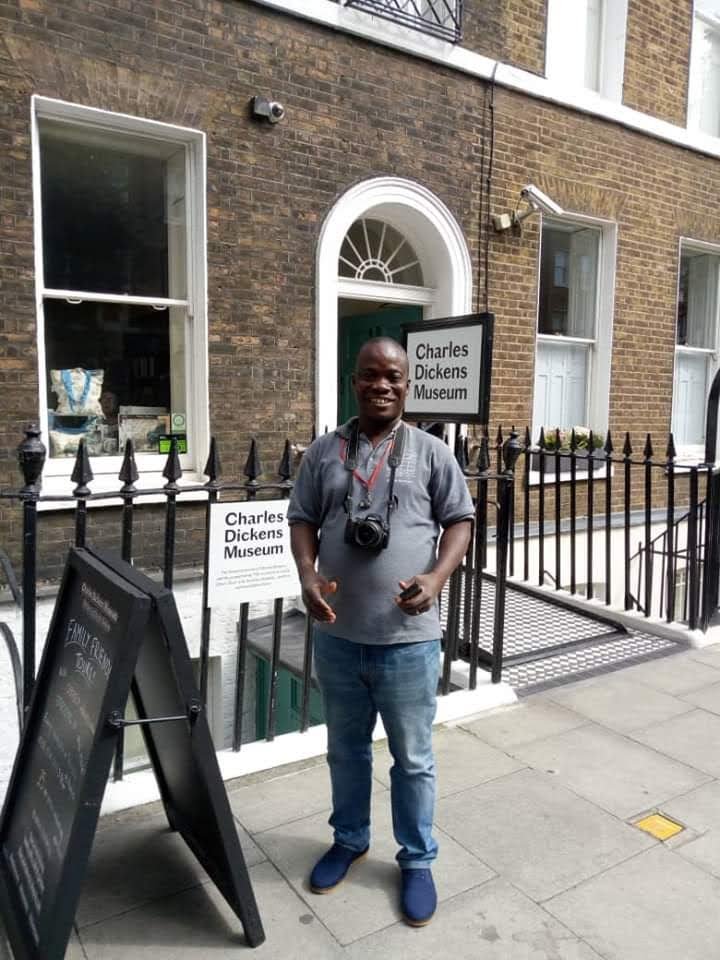
Before the second week of September, my training was over, and I was ready to come back home. One of my training colleagues, a grantee from Brazil, invited me on a tour of London. I could have visited Tower Bridge and other places that I have often read about while at home, but I had chosen what to see and where to go while the training was ongoing. I had visited the Charles Dickson museum to have an encounter of the home of the author of Oliver Twist. My nostalgia with that novel was a chapter or a part of it that kept ringing in my ear, years after I read it during my secondary school days – “Oliver asks for more.” That part of the story always reminds me of my humble beginnings in Eghwu-Urhobo, and brings up a kind of attachment with Oliver in his conditions. So, I wanted to visit the author's home to have a glimpse of the man who was creative enough to weave “my story” into a London boy many years ago. That was it – my visit to places in London in the evenings of my stay were uniquely attached to matters of memory, and now the training was over, and those memories were limited, I was prepared to go back home.
By mid-September, I was in the air on my way back home. The plane touched down in Lagos, through which I had flown to London Heathrow some days ago. From there, I took a flight to Osubi and went home to Effurun, my place of residence at that time. Apart from my family, I was not warmly welcomed back home.
My friends had heard that I had travelled out of Nigeria, even those that I had not told. In their minds, it was a japa trip, and they never expected me to return to Nigeria, if at all this soon. My visa had a duration of six months, and here I was back in Nigeria? Even those who had no knowledge of the types of travel visas were disappointed at my return.
“Bros, wetin you come back come do?” one of my friends asked me in Warri pidgin English. I explained that my visa was not a permanent document, and I had to come back.
“Bros, you no do well,” he retorted. “You for stay. People dey run enter street, dey hide for there.” He was obviously talking about overstaying a visa – a common trend with those who travel on a normal visa but with the intention to japa.
I had come back because I love my home here in Africa and because I had something to do with the training that I had gone there to get. I had to undertake the project of documenting the endangered traditional broom and fibre rope of my Urhobo people for archiving with the British Museum. If I had not returned, how would that be possible?
My explanations were not satisfactory to my disappointed friends who would not have done the same if they had gotten the same opportunity I had. It was clear from their expressions and expectations of me.
Japada, in the end, is more than a mere return; it is a deliberate choice rooted in identity, purpose, and belonging. My story challenges the assumption that success abroad outweighs commitment at home, and reminds us that fulfilling one’s calling, wherever it leads, can matter far more than distance or duration.
Shared by Akpobome Diffre-Odiete as part of the ADRRC Jápadà Archives.